
Shelf Registered Offerings in Solar & Renewable Energy: Market Access as Insurance Against Policy and Rate Volatility

Volatility & Event-Risk Landscape: When Capital Windows Depend on Forces Outside the Company
Solar and renewable energy companies operate inside a capital framework where policy, rates, and grid infrastructure often matter more to valuation than operating performance. Cash flows may be contracted, assets long-lived, and demand structurally supported, yet equity prices still respond sharply to interest-rate moves, tax-credit interpretation, interconnection delays, and election-driven policy rhetoric.
In 2024–2025, this fragility has become more pronounced. Rate volatility compresses equity multiples even as project-level returns remain intact. Transferability and monetization of tax credits evolve unevenly. Utility and grid bottlenecks delay CODs without impairing long-term asset value. For boards, the risk is not capital unavailability in principle—it is capital inaccessibility at the precise moment it is needed.
Shelf registered offerings enter the conversation not as a plan to raise equity, but as insurance against sudden window closures. The strategic objective is to ensure that access exists before volatility makes speed the dominant variable.
Why Speed Matters More Than Price
In renewable energy, missed windows often cost more than suboptimal pricing.
- Policy Events Reprice Overnight
Treasury guidance, election outcomes, or regulatory interpretation can open or close equity markets abruptly. Waiting for clarity before authorizing capital often means arriving too late. - Rate Moves Compress Timing, Not Value
Rising rates compress public multiples immediately, even though project IRRs may adjust slowly. Boards may want capital during dislocation—not after sentiment recovers. - Project and Portfolio Timing Is Lumpy
Development milestones, asset drops, or platform acquisitions rarely align neatly with market calm. When capital is required, it is often required quickly. - Live Offerings Are Penalized
Launching a financing reactively—without a shelf—signals urgency. In renewables, urgency is frequently misread as distress.
Speed, therefore, becomes a form of risk management. The shelf exists to buy speed without forcing execution.
Execution Readiness Curve: Why Preparation Changes Outcomes
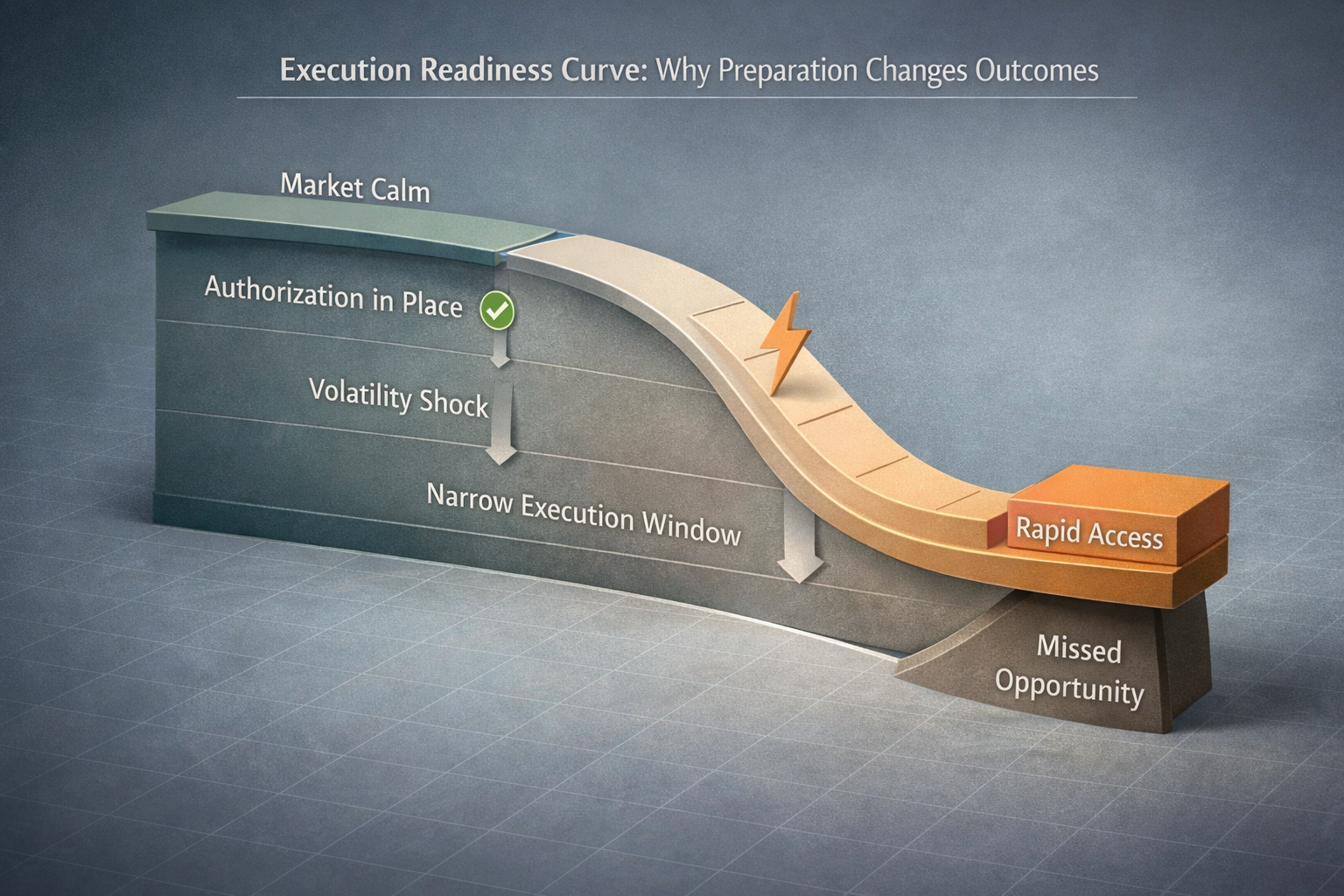
Interpretation:
The shelf shifts the company up the readiness curve before volatility arrives. When the window opens—briefly—the board can act without reopening approvals, disclosure, or strategy debates.
Shelf as Downside Protection, Not Dilution Intent
For solar and renewable energy issuers, the shelf functions as a defensive instrument even when never used.
Insulating Against Forced Capital Decisions
Authorization in advance prevents the board from having to choose between issuing equity at the wrong moment or foregoing strategic action entirely.
Preserving Negotiating Leverage
In asset acquisitions, partnerships, or portfolio recapitalizations, credible access to equity improves counterpart behavior—even if capital is not drawn.
Avoiding Signal Contamination
A shelf filing communicates preparedness. A rushed offering communicates need. In renewables, that distinction materially affects investor interpretation.
Maintaining Strategic Silence
The shelf allows execution without a prolonged “why now?” narrative that can destabilize sentiment in policy-sensitive markets.
The protection lies in optionality, not in issuance.
Friction & Resistance: Why Boards Hesitate—and Why They Should Reconsider
Despite its strategic value, shelf authorization often encounters resistance in renewable platforms.
- Fear of Dilution Optics
Some investors equate shelf capacity with intent. In practice, sophisticated allocators distinguish between authorization and execution—especially in capital-intensive sectors. - Overconfidence in Project Finance
While project-level capital may be available, corporate-level flexibility is still required for M&A, platform builds, or balance-sheet reinforcement. - Misplaced Desire for Certainty
Waiting for “the right moment” to authorize capital assumes that moments announce themselves in advance. They rarely do. - Governance Inertia
Boards sometimes defer shelf discussions to avoid appearing proactive in volatile markets—ironically increasing future pressure.
These frictions reflect cultural hesitation, not strategic logic.
Capital Deployed Only If Triggered: What Boards Actually Preserve
By maintaining a shelf, boards in solar and renewable energy preserve a set of asymmetric choices:
- Execute equity-linked capital if policy clarity or rate moves reopen valuation
- Backstop liquidity during grid, interconnection, or reimbursement delays
- Support M&A or asset aggregation during dislocation
- Decline to issue if conditions do not justify action
Crucially, the shelf protects the right not to act—without appearing constrained or unprepared.
Advisory Implications: Designing the Shelf for Volatility, Not Volume
Shelf Registered Offerings Advisory in solar and renewable energy is about engineering readiness, not forecasting issuance.
Effective advisors focus boards on:
- Sizing authorization to realistic volatility scenarios, not theoretical maxima
- Crafting disclosure language that emphasizes contingency, not intent
- Aligning shelf capacity with policy, rate, and project-risk exposure
- Establishing internal triggers for execution that are disciplined and narrow
- Maintaining investor communication that reinforces preparedness, not need
The advisory task is to ensure the shelf reduces downside risk without introducing unnecessary noise.
Closing: The Shelf as Volatility Insurance for Transition Capital
In solar and renewable energy, shelf registered offerings are not expressions of uncertainty about the transition or asset durability. They are acknowledgments that capital markets and policy regimes move faster than infrastructure can adjust.
By securing access in advance, boards protect against missed windows, forced decisions, and reactive financing. The shelf allows companies to participate in opportunity when it appears—or to stand still with confidence when it does not.
In this sector, shelf registrations do not price megawatts, PPAs, or tax credits.They price the board’s recognition that speed is sometimes more valuable than certainty—and its discipline to insure against volatility before it arrives.





Shelf Registered Offerings M&A in Aviation (Commercial & Charter Operators): Preserving Access When Utilization and Sentiment Decouple
Aviation equity trades on confidence as much as on cash flow. Fleet utilization, booking curves, fuel costs, labor negotiations, and geopolitical risk all influence sentiment long before they change economics.

Explore The Post Oak Group
From initial strategy to successful closing, The Post Oak Group delivers disciplined execution and senior-level guidance across both M&A and capital markets transactions.